Press Release
The media plays a crucial role in our commitment to Never Again. We work closely with our media partners to advance awareness and drive the narrative on the Yazidi Genocide. Yazda is widely quoted and cited in the global press. Thank you to our media partners for your persevering commitment to the Yazidi Cause.
We welcome media inquiries here.
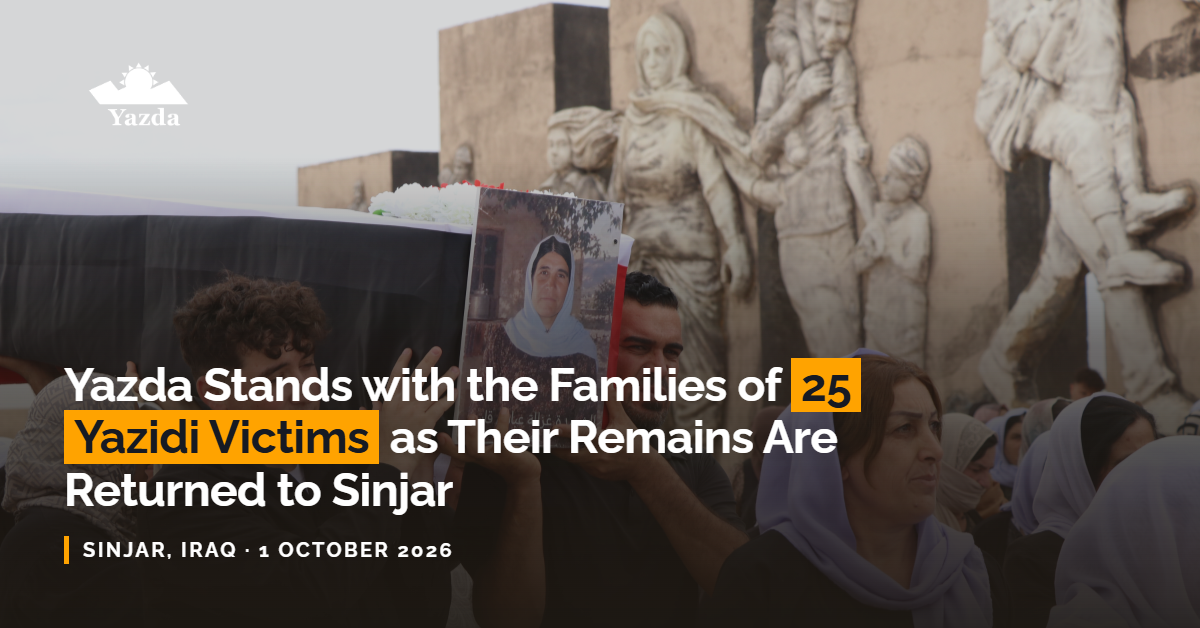
Yazda Stands with the Families of 25 Yazidi Victims as Their Remains Are Returned to Sinjar Sinjar, Iraq: Today, 1 October 2026, the remains of 25 Yazidi victims of ISIL are being transferred to the Yazidi Genocide Memorial in Solagh, Sinjar, where they will be handed over to their families following Yazidi religious rituals. The victims were killed in 2014, when ISIL launched its genocidal campaign against the Yazidi community in Sinjar. More than twelve years later, their families can finally lay them to rest. Of the 25 victims, who were children, women and menof different ages, 17 are from Kocho, four from Hardan, two from Tel Banat, one from Wardyia and one from Borek. Each family will bury their loved ones in their respective village, and three days of mourning will follow. They were identified through DNA matching, using blood samples provided by their relatives. They are men and women of different ages. This is the ninth group of remains of Yazidi victims to be returned to their families, bringing the total number of identified victims to 321, while around 530 remains are still awaiting identification. Natia Navrouzov, Executive Director at Yazda, commented: “Today, 25 families can finally lay their loved ones to rest, more than twelve years after they were taken from them. But every burial is also a painful reminder that the genocide is not something the Yazidi community can simply leave in the past. Each time remains are returned, wounds are reopened, not only for the families burying their loved ones, but for thousands of Yazidis who are still waiting for answers about those who were killed or remain missing. There can be no real healing while hundreds of remains are still awaiting identification and mass graves remain unopened. Every victim deserves to be identified, every family deserves the truth, and every person taken from their community deserves a dignified burial. This process must be completed, however long it takes. The families have already waited far too long.” For over a decade, Yazda has played a central role in documenting, supporting and advocating for the exhumation and identification of Yazidi genocide victims, and has stood with the families of the victims at every stage. In the lead-up to today's ceremony, Yazda has worked directly with the families, providing practical and logistical support for the burials and the three days of mourning. Yazda also provided support letters so that families of the victims living abroad could travel to Iraq and attend the ceremony, and Yazda's team is in contact with the families to offer condolences and support. Today, Yazda's teams are present at the ceremony in Solagh. The Mobile Medical Unit (MMU) is providing medical assistance to the families and community members, in coordination with the representative of the victims' families. Yazda's psychological support team is on site to support the families, and Yazda's Documentation Team is documenting the ceremony. Yazda presents its solidarity and condolences to all the affected families and reiterates its commitment to the pursuit of truth and justice. ### Download this Press Release here . Read this Press Release in Arabic here . For media inquiries, please contact: info@yazda.org About Yazda: Yazda is a non-governmental, non-profit organization that was established in 2014 in response to the genocide committed by the self-declared Islamic State (ISIS) against the Yazidis and other minorities in Iraq. Yazda manages a portfolio of humanitarian, justice, advocacy, and development-related projects, all of which are community and survivor-centered in terms of design and implementation. Since its inception, Yazda has been working with local and international partners to provide humanitarian, accountability, and advocacy services to vulnerable minority groups in Iraq in their post-genocide recovery. The organization has been operating in Iraq since October 2014 and has main offices in Duhok in the Kurdistan Region of Iraq and a branch office in Sinjar in Nineveh Province. Yazda is registered as a non-profit organization in the United States, the United Kingdom, Iraq, Kurdistan Region of Iraq. Over the past 8 years, Yazda has grown to employ around 80 staff on average, received support from numerous donors, both institutional and individual, and has reached tens of thousands of direct and indirect beneficiaries through its programs and initiatives.
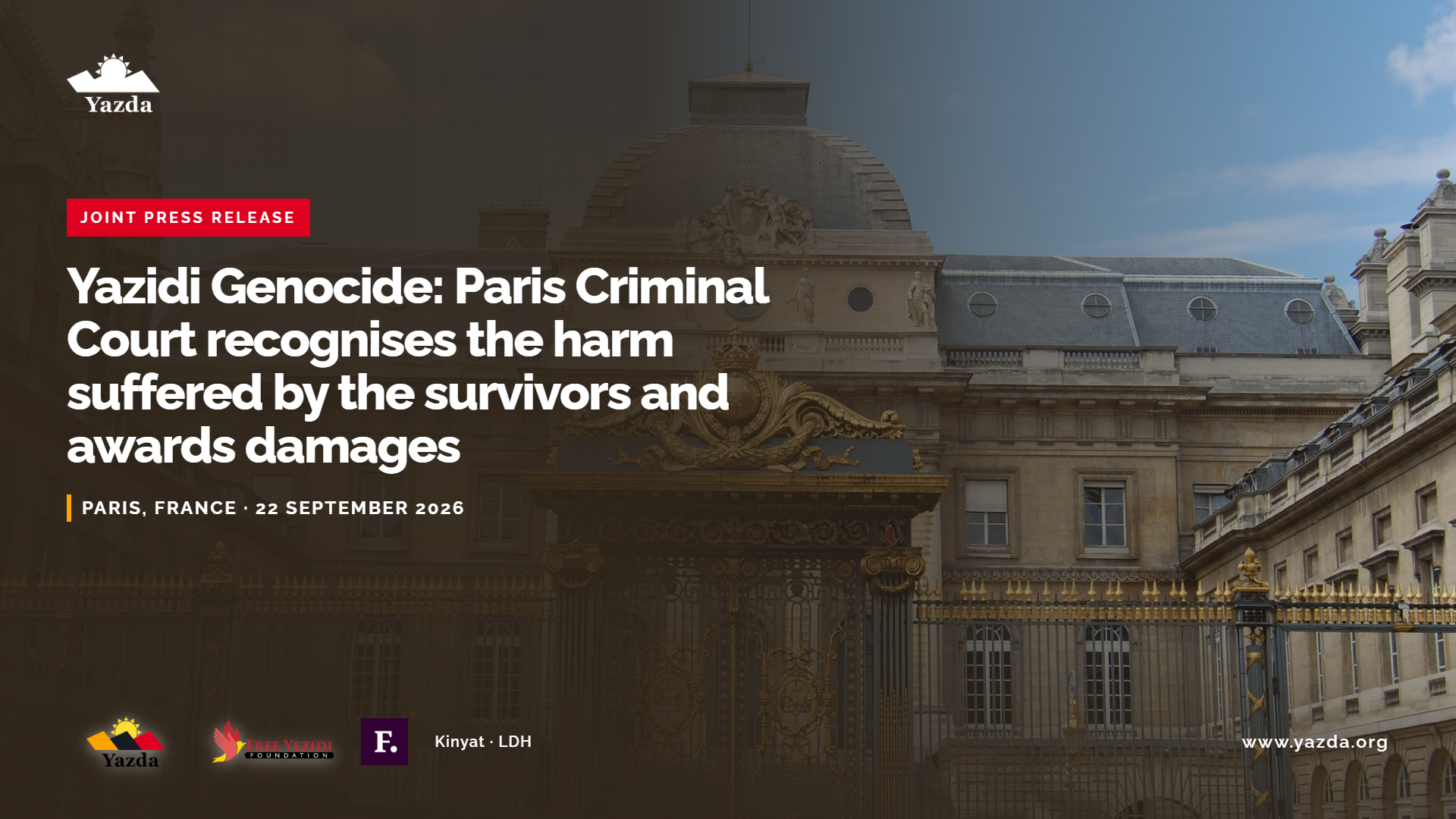
Yazidi Genocide: Paris Criminal Court Recognises the Harm Suffered by the Survivors and Awards Damages Following the conviction of Sabri Essid for genocide and crimes against humanity, the Paris Criminal Court has issued an important ruling on the civil claims, formally recognising the harm suffered by the civil parties and awarding them damages. This financial reparation will unfortunately remain very symbolic. Paris, 22 September 2026 . Six months after the historic conviction of French ISIS fighter Sabri Essid (alias Abou Dojanah al-Faransi), the Paris Criminal Court has issued its decision on the civil claims, providing judicial recognition of the lifelong and multifaceted harm suffered by the survivors of the Yazidi genocide. On 20 March 2026, Sabri Essid was sentenced in absentia to life imprisonment for genocide, crimes against humanity and complicity in these crimes, committed in Syria between August 2014 and throughout 2016 against Yazidi women and children. This marked the first conviction of a French national for genocide, as well as the first time that a French court addressed the atrocities committed by ISIS against the Yazidi community. In its decision on the civil claims, the Court formally recognised the extent of the harm inflicted by Sabri Essid on the three Yazidi women and their eight children, including the damage arising from the fear of impending death (prejudice d’angoisse de mort imminente), the loss of affection (prejudice d’affection) and the moral damage (préjudice moral), and granted them financial awards. The Court also acknowledged the moral damage suffered by the Yazidi associations that joined the proceedings as civil parties – Kinyat, the Free Yezidi Foundation (FYF) and Yazda – as well as by the International Federation for Human Rights (FIDH) and the Ligue des droits de l’Homme/droits humains (LDH) and awarded them one symbolic euro. In practice, these financial awards will unfortunately remain largely symbolic. As Sabri Essid has never been located, the victims cannot claim compensation from him. Additionally, under the current French legal framework, foreign victims of international crimes committed abroad are not eligible for compensation from the Commission d’indemnisation des victimes d’infractions (CIVI). “There can be no meaningful justice without effective reparation. Although this is an important decision, it will remain symbolic as French law does not allow foreign victims to have equal access to compensation mechanisms and to effectively benefit from reparations awarded by the courts, in cases where the accused is not present or solvent”, declared the five civil party associations. ### Download this Press Release here . Read this Press Release in Arabic here . Read this Press Release in French here . For media inquiries, please contact : info@yazda.org About Yazda: Yazda is a non-governmental, non-profit organization that was established in 2014 in response to the genocide committed by the self-declared Islamic State (ISIS) against the Yazidis and other minorities in Iraq. Yazda manages a portfolio of humanitarian, justice, advocacy, and development-related projects, all of which are community and survivor-centered in terms of design and implementation. Since its inception, Yazda has been working with local and international partners to provide humanitarian, accountability, and advocacy services to vulnerable minority groups in Iraq in their post-genocide recovery. The organization has been operating in Iraq since October 2014 and has main offices in Duhok in the Kurdistan Region of Iraq and a branch office in Sinjar in Nineveh Province. Yazda is registered as a non-profit organization in the United States, the United Kingdom, Iraq, Kurdistan Region of Iraq. Over the past 8 years, Yazda has grown to employ around 80 staff on average, received support from numerous donors, both institutional and individual, and has reached tens of thousands of direct and indirect beneficiaries through its programs and initiatives.
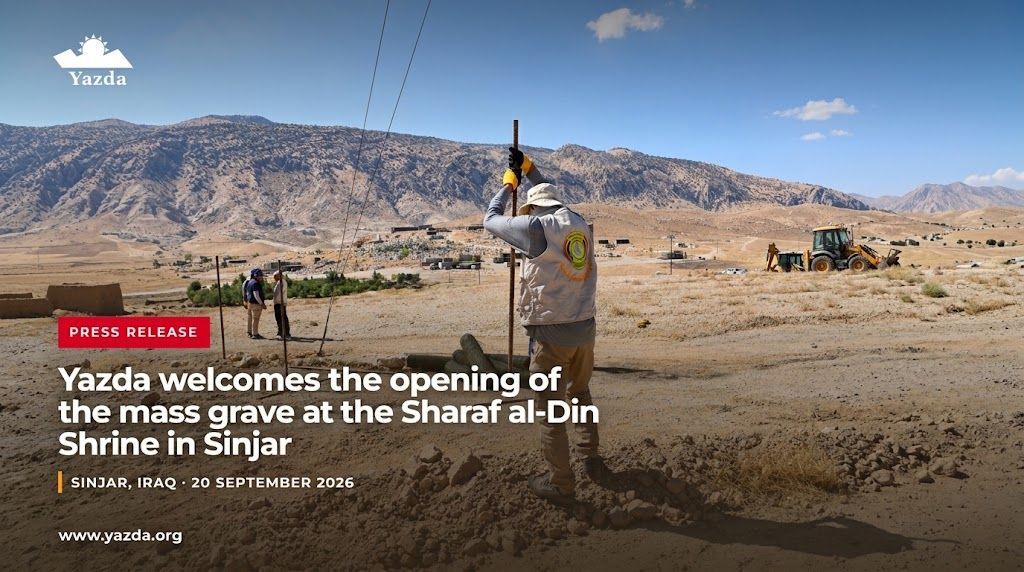
Yazda Welcomes the Opening of the Mass Grave at Sharaf al-Din Shrine in Sinjar Sinjar, Iraq: On 20 September 2026, in the presence of the families of the victims, a ceremony marked the beginning of the process to open the mass grave at the Sharaf al-Din Shrine, in northern Sinjar. The site holds the remains of Yazidi victims of ISIL who were uncovered from mass graves in the villages of Khanasor and Bardiya. The remains from those mass graves were first exhumed in 2015 by the authorities of the Kurdistan Region of Iraq (KRI) and reburied at the Sharaf al-Din Shrine in Sinjar on 13 August of that year, without DNA testing or formal identification. Since then, families of the missing, supported by civil society organizations, have repeatedly called on both the Kurdistan Regional Government and the Iraqi Federal Government to coordinate their efforts and finalize the identification process, so that the remains can be returned to their families for a dignified burial. A family member of one of the victims commented: "We have waited more than ten years, not knowing if our loved ones were truly the ones buried in that grave. Ten years is too long to carry that kind of doubt. The disagreements between the authorities were never ours to carry, they were not our burden to bear. All we ever wanted was the truth, and the chance to bury our loved ones with dignity, under their own names.” An agreement was finally reached following a key meeting held in Duhok in August , where Yazda joined Yazidi organizations, the International Commission on Missing Persons (ICMP), and Iraqi and Kurdistan Regional Government authorities to establish a joint mechanism for opening and exhuming this site. After years of advocacy by the families and civil society organizations, this agreement finally began to be implemented today, marking a long-awaited step toward the identification of the victims. Ismael Qasim, Yazda's Investigations Coordinator, commented: "Today, our team is present on the ground to document the exhumation, support the work of the institutions involved, and ensure that families remain informed and supported throughout every stage. We will continue to act as a bridge between the families, the relevant Iraqi and Kurdistan Regional Government authorities, and international organizations, facilitating coordination and providing the information needed to advance the identification process. Our commitment does not end with the exhumation. We will continue working alongside the families until their loved ones are identified and they can finally lay them to rest with dignity." The exhumation and related technical procedures will continue until 6 October 2026, after which the remains will be transferred to forensic medicine laboratories in Baghdad for DNA analysis and identification. Yazda presents its solidarity and condoleances to all the affected families and reiterates its commitment to the pursuit of truth and justice. ### Download this Press Release here . Read this Press Release in Arabic here . For media inquiries, please contact : info@yazda.org About Yazda: Yazda is a non-governmental, non-profit organization that was established in 2014 in response to the genocide committed by the self-declared Islamic State (ISIS) against the Yazidis and other minorities in Iraq. Yazda manages a portfolio of humanitarian, justice, advocacy, and development-related projects, all of which are community and survivor-centered in terms of design and implementation. Since its inception, Yazda has been working with local and international partners to provide humanitarian, accountability, and advocacy services to vulnerable minority groups in Iraq in their post-genocide recovery. The organization has been operating in Iraq since October 2014 and has main offices in Duhok in the Kurdistan Region of Iraq and a branch office in Sinjar in Nineveh Province. Yazda is registered as a non-profit organization in the United States, the United Kingdom, Iraq, Kurdistan Region of Iraq. Over the past 8 years, Yazda has grown to employ around 80 staff on average, received support from numerous donors, both institutional and individual, and has reached tens of thousands of direct and indirect beneficiaries through its programs and initiatives.
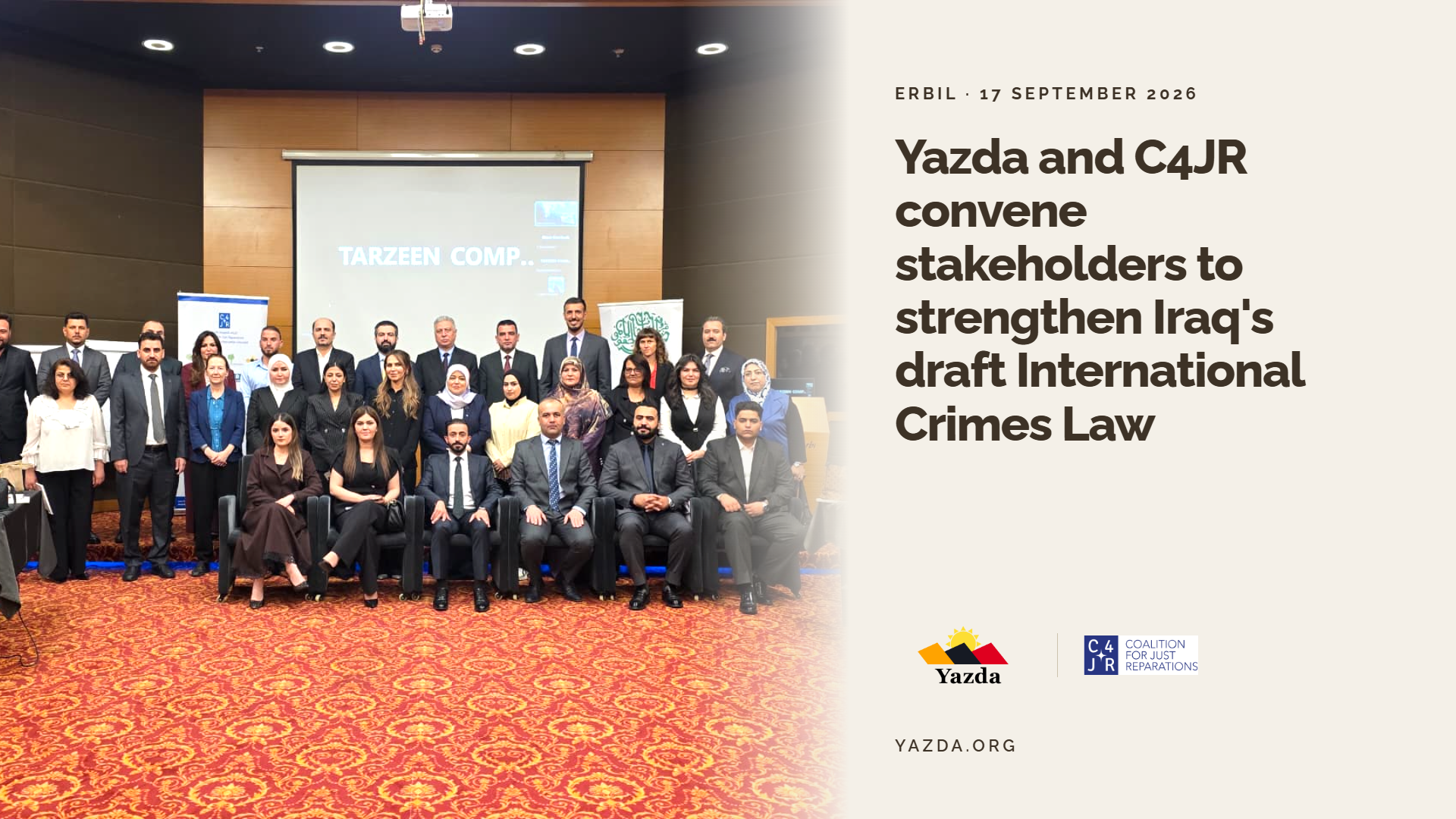
Yazda and C4JR Convene Stakeholders to Strengthen Iraq’s Draft International Crimes Law On 17 September, Yazda and the Coalition for Just Reparations (C4JR) co-organized a stakeholder consultation in Erbil on Iraq’s draft Law on Core International Crimes, which would provide a domestic legal framework for the prosecution of genocide, crimes against humanity, and war crimes in Iraq. The consultation brought together members of the Council of Representatives, Iraqi Government representatives, survivors, and civil society organizations to discuss the draft law, identify opportunities to strengthen its provisions in line with international standards, and promote survivor-centred accountability and victim protection. Survivor representatives from different affected communities delivered opening remarks, emphasizing the importance of survivor-centred accountability. Two members of the Survivors Rise Network (SRN), an advocacy platform bringing together survivors from diverse communities, also participated, helping ensure that survivors’ lived experiences and perspectives were directly represented in the discussion. The consultation took place at a key stage in the legislative process, following the Council of Ministers’ approval of the draft law on 24 August 2026 and its referral to the Council of Representatives. Since 2014, Yazda has advocated for justice and accountability for international crimes committed by ISIL in Iraq. Yazda led within C4JR the development of the Position Paper on an ISIL Accountability Mechanism in Iraq, published in 2022 and informed by survivors’ views. Building on this work, Yazda initiated a review of the current draft law, with support from Justice Rapid Response (JRR) and in consultation with C4JR members and survivors, to develop recommendations grounded in international standards and survivors’ perspectives. Natia Navrouzov, Executive Director at Yazda, commented: “It is rare to see members of Parliament, survivors and civil society organizations sitting together in one room to discuss how justice should be shaped. This positive workshop showed that such dialogue is possible, and we hope it will continue throughout the legislative process until the law is enacted. Survivors were deprived of their agency when these crimes were committed against them. They must now be at the forefront of shaping the law that is intended to bring them the justice they have awaited for so long. The measure of this law will not simply be the crimes it recognizes on paper, but whether survivors can access justice through it in practice.” The enactment of legislation addressing core international crimes would mark an important step toward accountability for ISIL crimes in Iraq. It would establish a domestic legal framework for prosecuting genocide, crimes against humanity, and war crimes, creating a pathway for survivors to pursue meaningful justice within Iraq’s legal system. The draft law is scheduled for its first reading before the Council of Representatives on 21 September. As the legislative process moves forward, meaningful survivor participation and strong safeguards for victims must remain central to the process.

Strengthening Survivor-Led Advocacy: Yazda Announces the Establishment of the Survivors Rise Network
Strengthening Survivor-Led Advocacy: Yazda Announces the Establishment of the Survivors Rise Network Date: 10 September 2026 Iraq: Yazda announces today the establishment of the Survivors Rise Network (SRN), an advocacy platform bringing together survivors from diverse communities. The SRN aims to strengthen collective action, foster mutual support, and promote the meaningful participation of survivors of the so-called Islamic State in Iraq and the Levant (ISIL) in decision-making processes. Guided by the Network’s vision, values, and priorities, members will lead joint advocacy efforts and engage with government institutions, civil society organizations, diplomatic missions, and international partners to build collaboration and advance long-term change. Since 2014, Yazda has worked alongside survivors of ISIL atrocities to advance justice, foster accountability, and promote survivors’ rights in Iraq. This work has included support for individual advocates, the establishment of the Yazidi Survivors Network (YSN) in 2019, and the launch of the Know Your Rights (KYR) Programme in 2024, equipping survivors with the knowledge, skills, and platforms to influence policy and champion their rights. Building on this foundation, the SRN was shaped through consultation and co-creation with KYR graduates and survivor advocates. By placing lived experience at its core, the Network seeks to translate survivors’ perspectives into coordinated action and leadership while remaining responsive to their evolving needs and constraints. Members of the Survivors Rise Network commented: "We are not merely survivors of the past—we are leaders shaping the future. Through the Survivors Rise Network, we come together from different communities, united by a shared commitment to justice, dignity, and the restoration of our rights. By standing together and leading our own advocacy, we transform our lived experiences into collective strength, ensuring that survivors are not only heard but are at the center of the decisions that shape our future." Yazda will support the SRN in its activities, championing this model and helping ensure that members are meaningfully positioned at the center of leadership, decision-making, and advocacy. Natia Navrouzov, Executive Director at Yazda, commented: "Working with and for survivors has been at the heart of Yazda's mission since our founding. Over the past twelve years, we have supported individual survivor advocates and helped create spaces where survivors can organize, lead, and shape the policies that affect their lives. The Survivors Rise Network represents the culmination of that journey and of a year of consultations with survivors themselves. It transforms the lessons we have learned into a sustainable, survivor-led platform for collective advocacy. We call on governments, donors, civil society, and international partners to engage with the Network, amplify survivors' voices, and invest in their long-term leadership and advocacy." The SRN was established with the support of the SPACE Programme, funded by the Government of the Federal Republic of Germany and implemented by GIZ. Yazda and SRN members extend their sincere gratitude for this valuable partnership and continued commitment to advancing survivor-led initiatives in Iraq. ### Download this Press Release here . Read this Press Release in Arabic here . For media inquiries, please contact: info@yazda.org About Yazda: Yazda is a non-governmental, non-profit organization that was established in 2014 in response to the genocide committed by the self-declared Islamic State (ISIS) against the Yazidis and other minorities in Iraq. Yazda manages a portfolio of humanitarian, justice, advocacy, and development-related projects, all of which are community and survivor-centered in terms of design and implementation. Since its inception, Yazda has been working with local and international partners to provide humanitarian, accountability, and advocacy services to vulnerable minority groups in Iraq in their post-genocide recovery. The organization has been operating in Iraq since October 2014 and has main offices in Duhok in the Kurdistan Region of Iraq and a branch office in Sinjar in Nineveh Province. Yazda is registered as a non-profit organization in the United States, the United Kingdom, Iraq, Kurdistan Region of Iraq. Since its creation, Yazda has received support from numerous donors, both institutional and individual, and has reached tens of thousands of direct and indirect beneficiaries through its programs and initiatives. About the Survivors Rise Network: The Survivors Rise Network (SRN) is an inclusive, survivor-led platform that brings together trained survivor advocates from different communities to strengthen collective advocacy, promote collaboration and meaningful survivor participation, and engage with institutions and partners to advance the rights of survivors of ISIL atrocities. By working collectively, the Network seeks to strengthen survivor leadership and contribute to more inclusive and survivor-centred policies and decision-making processes. Guided by the principles of survivor leadership, inclusion, dignity, respect, a survivor-centred approach, and Do No Harm, the Network advocates for truth, justice, reparations, accountability, and guarantees of non-repetition. This project was implemented as part of SPACE. SPACE is funded by Government of the Federal Republic of Germany and supported by the Deutsche Gesellschaft für Internationale Zusammenarbeit (GIZ) GmbH.
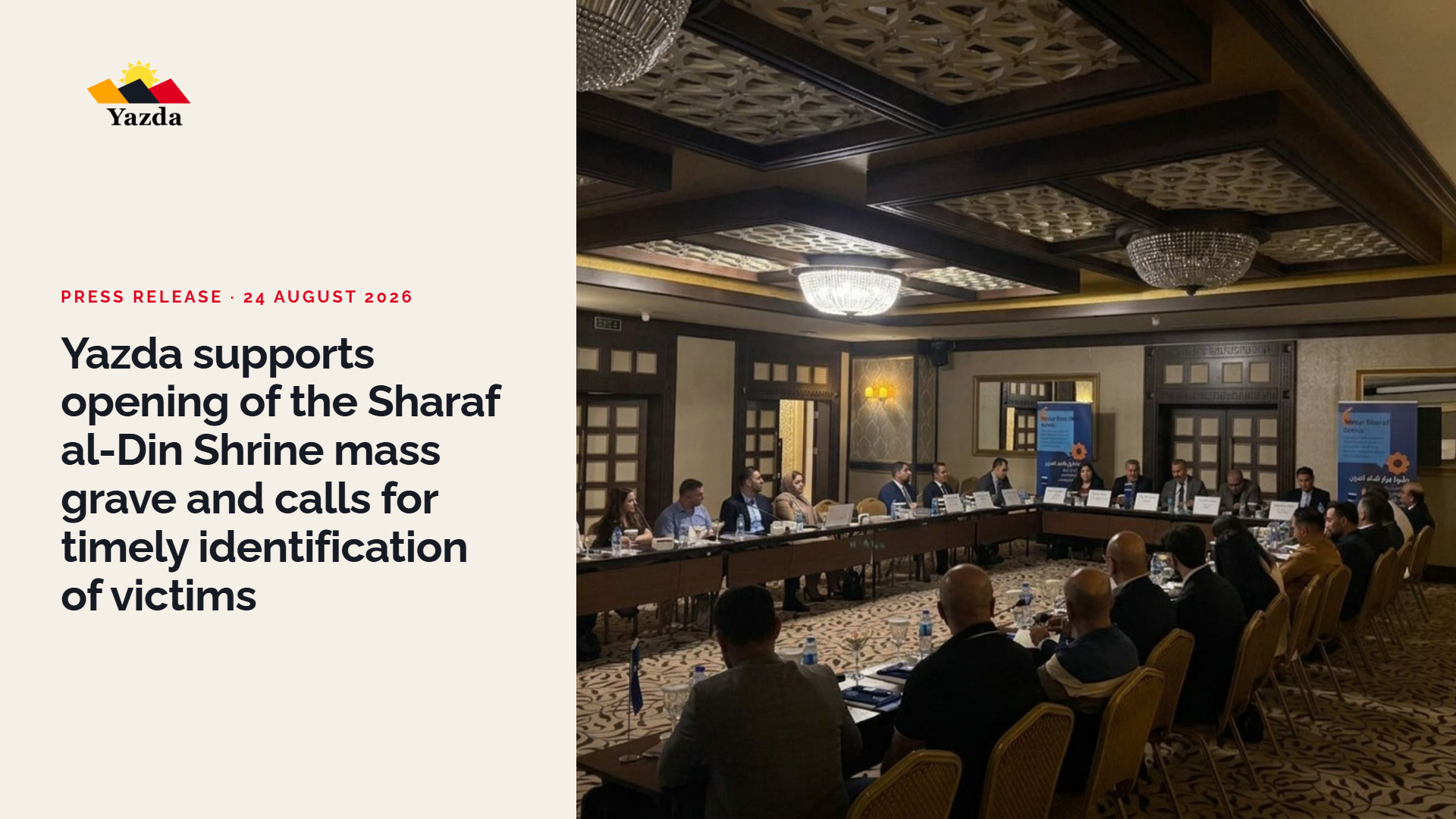
Yazda Supports Opening of Sharaf al-Din Shrine Mass Grave and Calls for Timely Identification of Victims Iraq: On 20 August 2026, Yazda joined Yazidi organizations in a key meeting organized by the International Commission on Missing Persons (ICMP) in Duhok, focused on establishing a joint mechanism to open and exhume the mass grave at the Sharaf al-Din Shrine in the Al-Shimal subdistrict (Sinuni), northern Sinjar. The site holds the remains of victims from the Khanasor and Bardiya mass graves. The meeting was attended by families of the victims as well as the Iraqi government, including the Mass Graves and Missing Persons Protection Directorate at the Martyrs Foundation and the Directorate of Forensic Medicine at the Ministry of Health. Representatives from the Kurdistan Regional Government's Directorate of Forensic Medicine, the Criminal Evidence Department at the Ministry of Interior, and the Commission of Investigation and Evidence Gathering also attended. The Iraqi federal government and the Kurdistan Regional Government will continue to coordinate closely on this process, including by cross-referencing available information and consolidating data on the two mass graves in a dedicated database at the Directorate of Forensic Medicine in Baghdad. These efforts are intended to facilitate the DNA matching process and support the identification of the victims. On 21 August 2026, national technical teams from the Mass Graves and Missing Persons Protection Directorate and the Directorate of Forensic Medicine, in partnership with ICMP, began a field mission at the site to conduct an initial technical assessment and prepare for the next stages of the survey. This work is being carried out in preparation for the official opening of the mass grave on 19 September 2026. Following the exhumation, the remains will be transferred, in accordance with official procedures, to forensic medicine laboratories in Baghdad for DNA analysis and matching. Yazda will continue to support the families and national technical teams throughout this humanitarian mission and will closely follow the identification and DNA matching process in the stages ahead. Yazda also calls on all relevant authorities to prioritize this process and ensure that the necessary resources, coordination, and technical support are in place to bring it to a timely conclusion. More than 12 years after the genocide, families have waited far too long for answers about the fate of their loved ones and for the opportunity to lay them to rest with dignity. Completing the exhumation, identification, and return of the remains should therefore be treated as a matter of urgency and as an essential step toward providing families with truth, dignity, and closure. ### Download this Press Release here . Read this Press Release in Arabic here . For media inquiries, please contact: info@yazda.org About Yazda: Yazda is a non-governmental, non-profit organization that was established in 2014 in response to the genocide committed by the self-declared Islamic State (ISIS) against the Yazidis and other minorities in Iraq. Yazda manages a portfolio of humanitarian, justice, advocacy, and development-related projects, all of which are community and survivor-centered in terms of design and implementation. Since its inception, Yazda has been working with local and international partners to provide humanitarian, accountability, and advocacy services to vulnerable minority groups in Iraq in their post-genocide recovery. The organization has been operating in Iraq since October 2014 and has main offices in Duhok in the Kurdistan Region of Iraq and a branch office in Sinjar in Nineveh Province. Yazda is registered as a non-profit organization in the United States, the United Kingdom, Iraq, Kurdistan Region of Iraq. Over the past 8 years, Yazda has grown to employ around 80 staff on average, received support from numerous donors, both institutional and individual, and has reached tens of thousands of direct and indirect beneficiaries through its programs and initiatives.
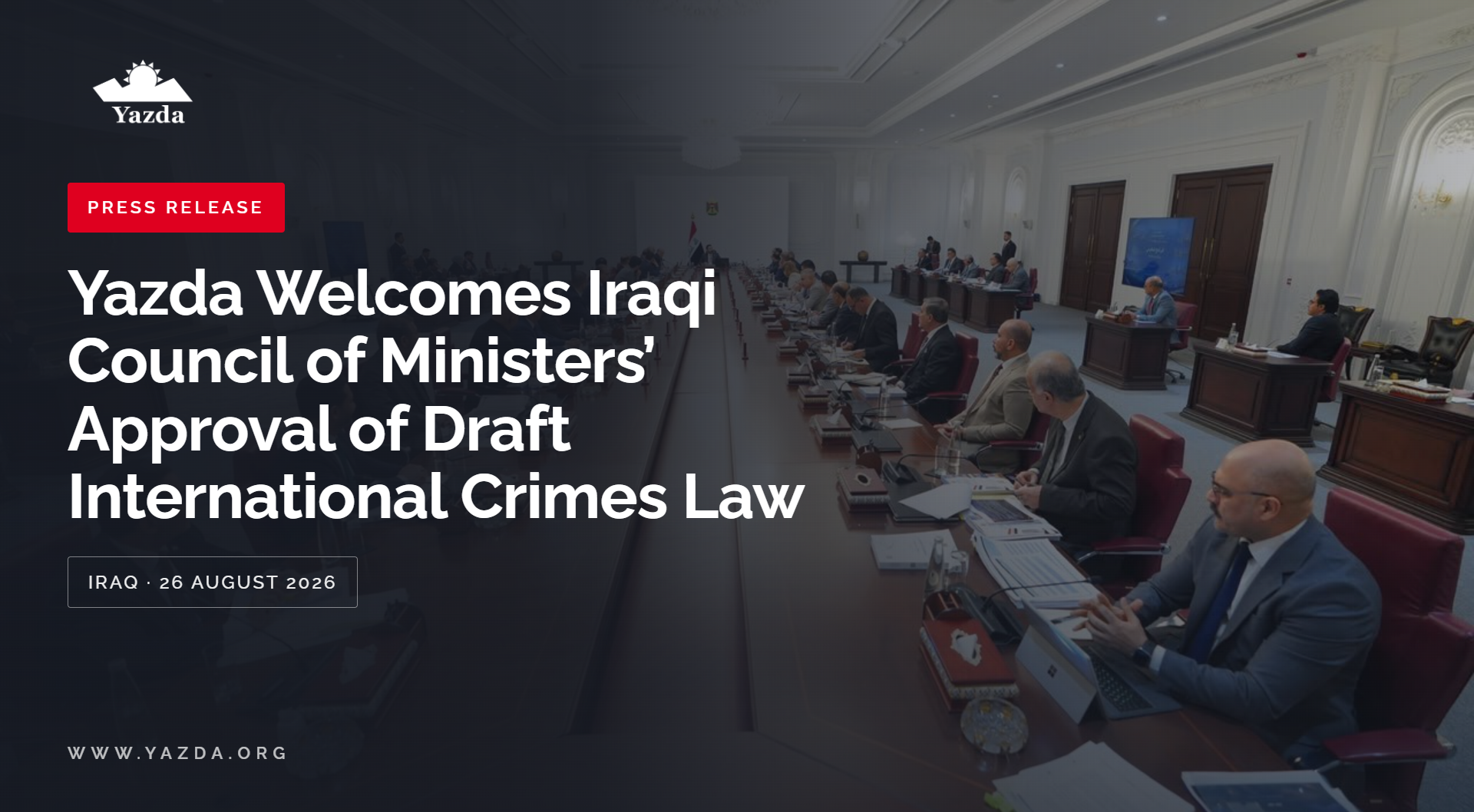
Yazda Welcomes Iraqi Council of Ministers’ Approval of Draft International Crimes Law 26 August 2026 Iraq - Yazda welcomes the Iraqi Council of Ministers’ approval, on 24 August 2026, of the draft International Crimes Law and its referral to the Iraqi Council of Representatives following review by the State Council. The draft law represents an important step toward establishing a domestic legal framework for the prosecution of genocide, crimes against humanity and war crimes in Iraq. If adopted by the Council of Representatives and brought into force, it could provide a long-awaited legal basis for prosecuting perpetrators for core international crimes committed by the Islamic State of Iraq and the Levant (ISIL). For years, Yazda, survivors, victims’ families and civil society organizations have advocated for an Iraqi legal framework capable of reflecting the nature, gravity and scale of the crimes committed by ISIL against the Yazidi community and other affected communities. To date, ISIL members in Iraq have largely been prosecuted under counter-terrorism legislation, as Iraqi criminal law does not codify genocide, crimes against humanity and war crimes as distinct offences. These proceedings have therefore generally focused on terrorism-related offences rather than establishing individual criminal responsibility for the specific international crimes committed against Yazidis and other affected communities. The recent transfers of ISIL detainees from northeastern Syria to Iraq have created a renewed opportunity to address this accountability gap and ensure that those suspected of core international crimes can be prosecuted for the full scope of their conduct. This makes the establishment of an appropriate domestic legal framework all the more urgent. In the absence of such a domestic framework, proceedings in third countries have played a critical role in advancing accountability. Cases before European courts have resulted in prosecutions and convictions for genocide, crimes against humanity and war crimes and, importantly, have provided some survivors with opportunities to participate meaningfully in proceedings concerning the crimes committed against them. These cases have demonstrated that ISIL atrocities can be successfully prosecuted as core international crimes and have contributed to establishing a judicial record of the Yazidi genocide. However, third-country prosecutions can reach only a limited number of perpetrators and depend on factors such as jurisdiction, the location of suspects and the availability of evidence. Establishing an effective framework in Iraq is therefore essential to creating a more comprehensive and sustainable pathway to justice. In 2022, Yazda and the Coalition for Just Reparations (C4JR) published the Position Paper on an ISIL Accountability Mechanism in Iraq. Developed through extensive discussions among C4JR members and informed by survivors’ views, Iraqi and international law, and lessons from previous accountability processes, the paper set out recommendations for a survivor-centered mechanism capable of addressing genocide, crimes against humanity and war crimes committed by ISIL. It emphasized that survivors should be meaningfully involved and that their rights and needs should be respected throughout criminal proceedings. The Council of Ministers’ approval of the draft International Crimes Law is an important step toward addressing this longstanding accountability gap. The draft has now been referred to the Iraqi Council of Representatives, where it will enter the parliamentary legislative process. Parliamentary consideration and the required readings will follow in accordance with applicable procedures. At the time of publication, a date for the first reading has not been officially announced. As Parliament considers the draft, Yazda calls on lawmakers to ensure that the final legislation meets the needs of survivors and victims and provides an effective basis for accountability. In particular, Yazda calls on the Council of Representatives and relevant Iraqi authorities to: 1. Ensure meaningful survivor and civil society participation. Survivors, victims’ families, civil society organizations, and Iraqi and international experts should have genuine opportunities to contribute their expertise and recommendations during the parliamentary process. 2. Embed survivor-centered safeguards in the legal framework. The law and its implementation should protect the safety, dignity, privacy, and physical and psychological well-being of survivors and victims, including survivors of conflict-related sexual violence and children affected by ISIL crimes. 3. Guarantee meaningful participation in criminal proceedings. Survivors and victims should have appropriate opportunities to participate in proceedings concerning crimes committed against them, be heard, receive information about proceedings, and exercise their rights in accordance with international standards. 4. Ensure access to reparations. The legal framework should provide effective avenues for victims and survivors to seek appropriate forms of reparation and complement existing Iraqi mechanisms for reparations and survivor support. Natia Navrouzov, Yazda’s Executive Director, said: “This is a significant moment for survivors who have waited more than a decade to see the crimes committed against them addressed for what they are. For years, survivors have travelled abroad, testified before foreign courts and contributed to cases far from their homes in order to pursue justice for genocide, crimes against humanity and war crimes. Iraq now has an important opportunity to build on those efforts and create a pathway to justice closer to the communities most affected. The measure of this law will not simply be the crimes it recognizes on paper, but whether survivors can access justice through it in practice. Survivors, victims’ families and civil society have brought the accountability process this far. Their experience should now help shape a law that can deliver meaningful justice in Iraq.” Yazda calls on the Council of Representatives to prioritize consideration of the draft International Crimes Law and stands ready to engage with Parliament, relevant Iraqi authorities, survivors, C4JR members, civil society organizations and other stakeholders throughout the legislative process. ### Download this Press Release here . Read this Press Release in Arabic here . For media inquiries, please contact: info@yazda.org About Yazda: Yazda is a non-governmental, non-profit organization that was established in 2014 in response to the genocide committed by the selfdeclared Islamic State (ISIS) against the Yazidis and other minorities in Iraq. Yazda manages a portfolio of humanitarian, justice, advocacy, and development-related projects, all of which are community and survivor-centered in terms of design and implementation. Since its inception, Yazda has been working with local and international partners to provide humanitarian, accountability, and advocacy services to vulnerable minority groups in Iraq in their post-genocide recovery. The organization has been operating in Iraq since October 2014 and has main offices in Duhok in the Kurdistan Region of Iraq and a branch office in Sinjar in Nineveh Province. Yazda is registered as a non-profit organization in the United States, the United Kingdom, Iraq, Kurdistan Region of Iraq. Since its creation, Yazda has received support from numerous donors, both institutional and individual, and has reached tens of thousands of direct and indirect beneficiaries through its programs and initiatives.
Yazda formalizes partnership with the Independent Institution on Missing Persons in the Syrian Arab Republic (IIMP) Geneva/Sinjar, 18 August 2026 – Yazda and the Institution on Missing Persons in the Syrian Arab Republic (IIMP) signed a Memorandum of Understanding (MoU) formalizing their cooperation to strengthen the sharing of information and documentation to clarify the fate of all missing persons and support their families. Established by the United Nations General Assembly through resolution 77/301 in June 2023, following sustained advocacy by Syrian families of the missing and civil society, the Independent Institution on Missing Persons in the Syrian Arab Republic (IIMP) is mandated to clarify the fate and whereabouts of all missing persons in Syria and to provide adequate support to victims, survivors and the families of those who are missing. The Institution works in close cooperation and complementarity with relevant actors, placing families at the centre of its efforts and supporting a coordinated, inclusive and humanitarian approach to addressing the issue of missing persons. Yazda is a global Yazidi-led, survivor-centered organization dedicated to protecting the rights of the Yazidi community and supporting survivors of atrocities committed by the Islamic State of Iraq and the Levant (ISIL). Established in 2014, Yazda works across justice and accountability, advocacy, humanitarian assistance, and community recovery, including supporting the documentation and prosecution of genocide, crimes against humanity, and war crimes committed against Yazidis. Yazda also supports the families of missing Yazidis by advancing efforts to determine the fate of those who remain unaccounted for following the genocide. Through the identification of victims from mass graves, the collection of DNA reference samples, and advocacy for families' right to know what happened to their loved ones, Yazda helps provide long-awaited answers to families while supporting justice and preserving the historical record. As many Yazidis remain missing, Yazda's long-standing experience documenting cases of missing persons, combined with IIMP's mandate and expertise in data management will support families' right to know the truth about their loved ones' fate through a victim and survivor centred approach. This partnership aims to ensure that information and documentation on missing persons are responsibly preserved, protected, and can support future justice processes while safeguarding the rights and well-being of survivors and their families. Natia Navrouzov, Yazda Executive Director, stated : "Since 2014, Yazda has supported efforts to identify, protect, and document mass grave sites, facilitating cooperation among national authorities, forensic experts, and international mechanisms on exhumations and investigations in line with international standards. By partnering with the IIMP, we will amplify truth-seeking efforts and work jointly to promote the rights and dignity of victims, survivors, and their families." Karla Quintana, the Head of the Independent Institution on Missing Persons in the Syrian Arab Republic (IIMP) , stated: "Families have spent years searching for answers about the fate and whereabouts of their loved ones. Partnerships such as this one are essential because they help ensure that valuable information is preserved, handled responsibly and can contribute to a coordinated search effort. We welcome Yazda's commitment and look forward to working together in support of victims, survivors and families." ### Download this Press Release here . Read this Press Release in Arabic here . For media inquiries, please contact: info@yazda.org About Yazda: Yazda is a non-governmental, non-profit organization that was established in 2014 in response to the genocide committed by the self-declared Islamic State (ISIS) against the Yazidis and other minorities in Iraq. Yazda manages a portfolio of humanitarian, justice, advocacy, and development-related projects, all of which are community and survivor-centered in terms of design and implementation. Since its inception, Yazda has been working with local and international partners to provide humanitarian, accountability, and advocacy services to vulnerable minority groups in Iraq in their post-genocide recovery. The organization has been operating in Iraq since October 2014 and has main offices in Duhok in the Kurdistan Region of Iraq and a branch office in Sinjar in Nineveh Province. Yazda is registered as a non-profit organization in the United States, the United Kingdom, Iraq, Kurdistan Region of Iraq. Over the past 8 years, Yazda has grown to employ around 80 staff on average, received support from numerous donors, both institutional and individual, and has reached tens of thousands of direct and indirect beneficiaries through its programs and initiatives. About IIMP: The Independent Institution on Missing Persons in the Syrian Arab Republic (IIMP) is a humanitarian and independent UN entity, established by the UN General Assembly on 29 June 2023 in response to urgent calls for action from family members of Syria's thousands of missing persons to determine their fate and whereabouts. It has a unique and unprecedented mandate, as it is the first UN body focused on missing persons in a specific context. Its mission is to clarify the fate and whereabouts of all missing persons in Syria, and to provide adequate support to the families of those missing. The Institution's work is built on a victim-centred approach, the full and meaningful participation of families and survivors, non-duplication and cooperation with existing actors, and gender sensitivity and inclusivity across all areas of its work.
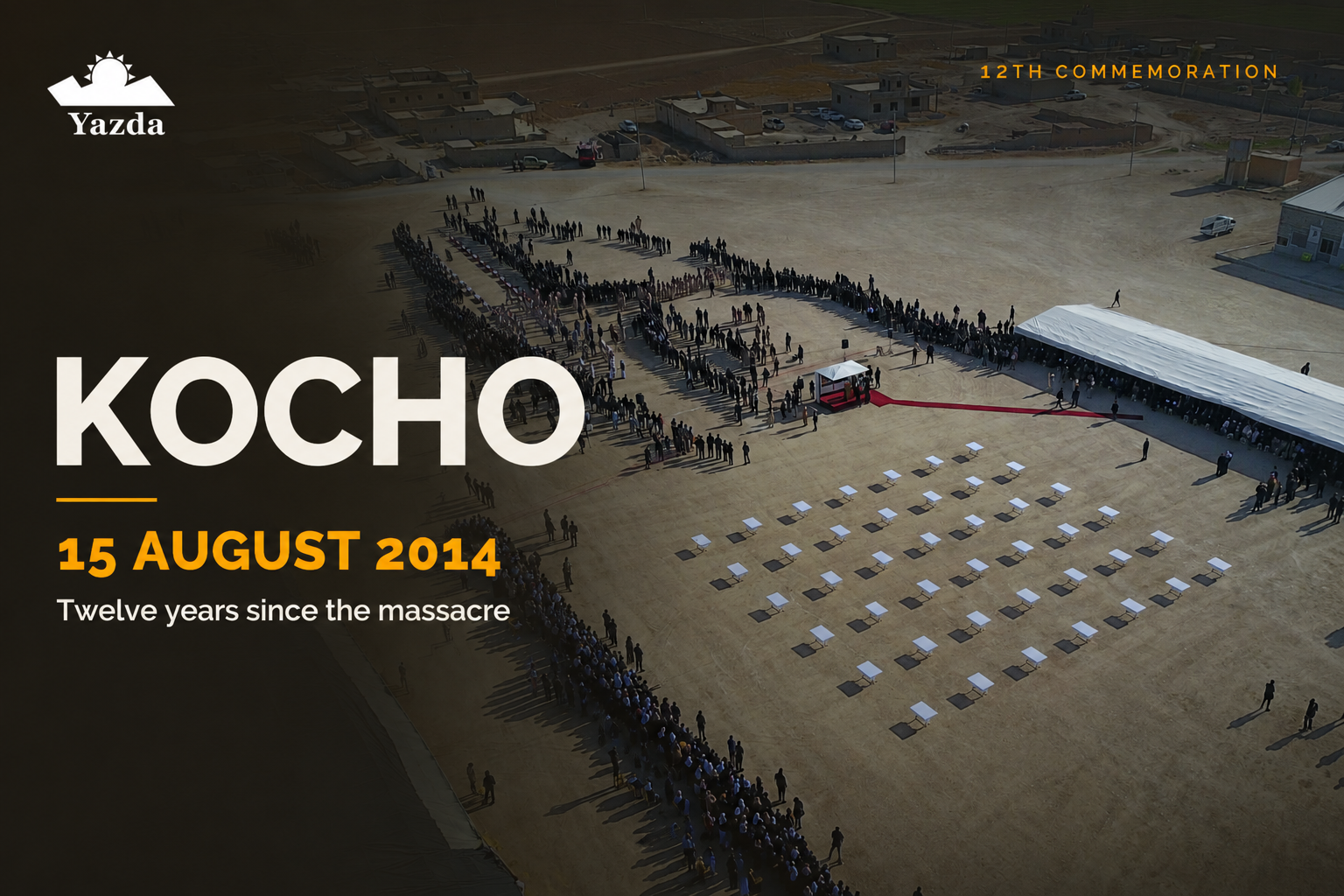
Yazda Statement for the 12th Commemoration of the Kocho Village massacre in Sinjar 15 August 2026 Today marks the 12th commemoration of the attacks on Kocho village in Sinjar. Kocho was once a vibrant community. It became a symbol of unimaginable suffering following the atrocities committed by ISIL from August 2014. Following ISIL's attack on Sinjar, the group surrounded Kocho for twelve days, holding more than 1,700 people in the village between 3 and 15 August 2014. On 15 August, ISIL gathered the inhabitants in the village school and separated the men and older boys from the women and children. The men and boys were executed and buried in 17 mass graves across the village. Eighty-six women were separated out and massacred near Solagh. The remaining women and children were taken captive and subjected to torture, forced conversion, sexual violence, and enslavement. The survivors of Kocho, both women and men, have shown remarkable courage in preserving the memory of their community and speaking publicly about the atrocities they endured. Through their testimonies and continued efforts to seek justice and accountability, they have helped bring the experiences of Kocho and the broader Yazidi genocide to national and international attention. Their voices have played an important role in ensuring that these crimes are documented, remembered, and recognized, and that the rights of victims and survivors, as well as the pursuit of justice, remain central to efforts to address the Yazidi genocide. Kocho survivors and members of Survivors Rise Network shared what this day means to them. Azhar Suhail, Kocho survivor , said: "On August 15, 2014, it was not only lives that were taken in Kocho, an entire childhood was stolen from its children, and I was one of the children. They took us captive, they took our women, and they left behind a bleeding village and a memory that refuses to die. Twelve years later, I am still here… to say: Kocho has not died, as long as there are survivors who remember and bear witness." Thikran Mato, Kocho survivor and Yazda consultant , said: "Twelve years after the Kocho genocide, memory is no longer simply a way of recalling a painful past for me, it has become an act of bearing witness and an act of resistance. As a survivor of Kocho, I carry the responsibility of documenting what happened and preserving the voices of the victims. Memory does not simply preserve the past; it is the foundation for justice and for preventing genocide from happening again." Widad Dawod, Kocho survivor , said: "We have been worn down by years of waiting for our kidnapped loved ones to return, or to recover their remains. How much longer? Is 12 years not enough? My question to every official is: When will I be able to bury my son's remains? I used to believe that with each passing year, the pain of separation and suffering would become easier to bear. But every year, the pain only grows. I no longer know what peace feels like. We will not forget." Yazda's commitment goes beyond remembrance. We remain steadfast in our resolve to support the Yazidi community's ongoing efforts for justice, recovery, and rebuilding. We acknowledge the deep scars left by these atrocities and pledge to advocate tirelessly for the protection of human rights and to work toward preventing future genocides. In honoring Kocho, we also recognize the urgent need for continued solidarity and action to uncover the fate of missing persons, support their families, and bring justice to the victims and survivors of these atrocities. ### Download this Press Release here . Read this Press Release in Arabic here . For media inquiries, please contact: info@yazda.org About Yazda: Yazda is a non-governmental, non-profit organization that was established in 2014 in response to the genocide committed by the self-declared Islamic State (ISIS) against the Yazidis and other minorities in Iraq. Yazda manages a portfolio of humanitarian, justice, advocacy, and development-related projects, all of which are community and survivor-centered in terms of design and implementation. Since its inception, Yazda has been working with local and international partners to provide humanitarian, accountability, and advocacy services to vulnerable minority groups in Iraq in their post-genocide recovery. The organization has been operating in Iraq since October 2014 and has main offices in Duhok in the Kurdistan Region of Iraq and a branch office in Sinjar in Nineveh Province. Yazda is registered as a non-profit organization in the United States, the United Kingdom, Iraq, Kurdistan Region of Iraq. Over the past 8 years, Yazda has grown to employ around 80 staff on average, received support from numerous donors, both institutional and individual, and has reached tens of thousands of direct and indirect beneficiaries through its programs and initiatives.
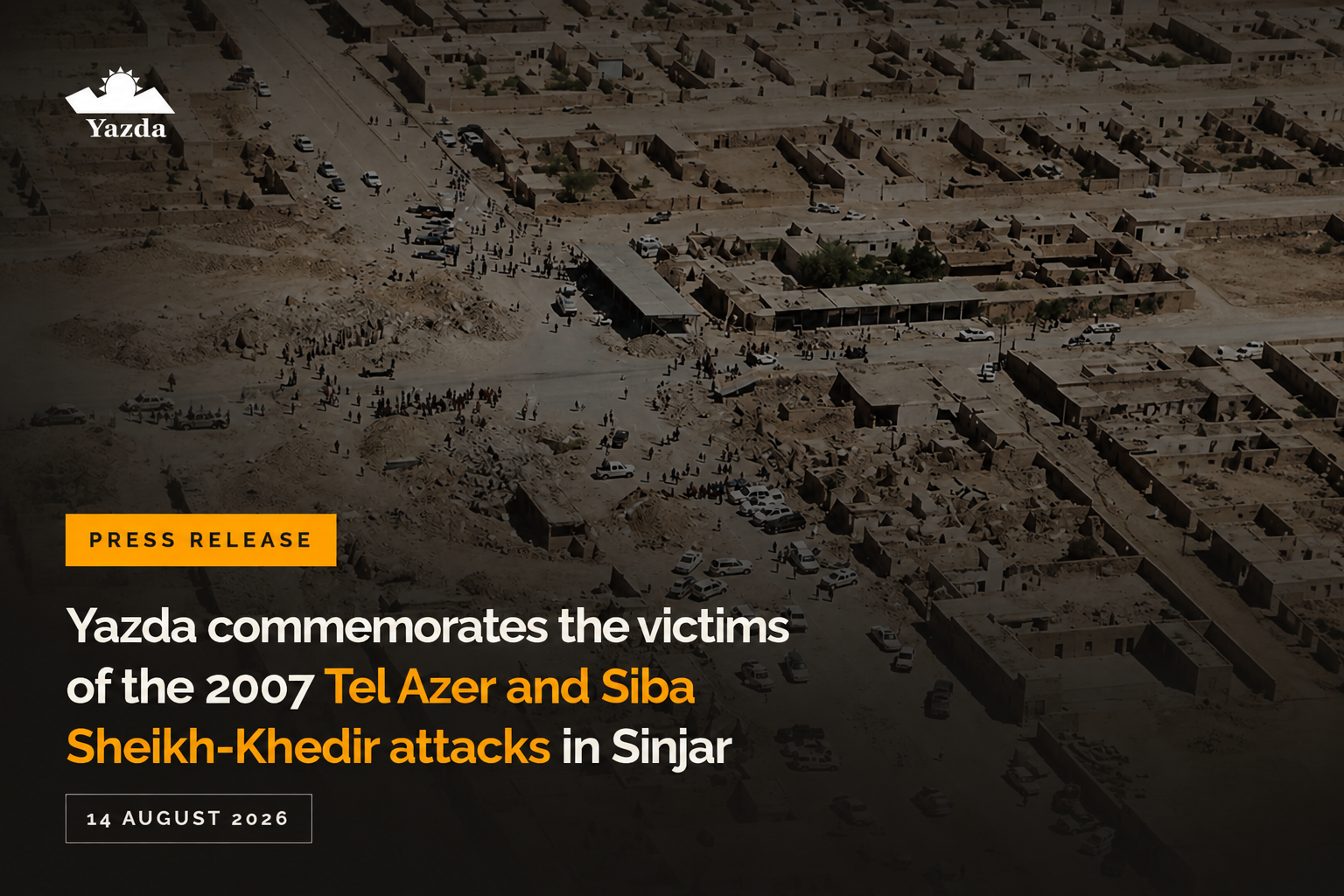
Yazda Commemorates the Victims of the 2007 Tel Azer and Siba Sheikh-Khedir Attacks in Sinjar 14 August 2026 Sinjar, Iraq: Today marks nineteen years since the coordinated terrorist attacks that struck the Yazidi communities of Tel Azer and Siba Sheikh-Khedir in Sinjar, Iraq, on 14 August 2007. The attacks remain among the deadliest acts of terrorism ever carried out against the Yazidi people. Tel Azer, Seba Sheikh Khidr, and Old Azer Village sit in Sinjar, west of Mosul and south of Mount Sinjar, near the Syrian border, a predominantly Yazidi area administratively part of Al-Ba'aj District in Nineveh Governorate. On that day, coordinated explosions tore through the three villages, reducing homes to rubble and causing a catastrophic humanitarian crisis. The attacks left an estimated 1,800 people killed and injured across the three villages. In the aftermath, search efforts recovered 41 human remains, many of them unidentifiable, which were buried collectively in a mass grave at the Sheikh Mand Shrine in Wadi Jadal Village. To this day, a significant number of survivors continue to live with permanent disabilities, paralysis, and severe head injuries because of the attacks. The destruction extended to housing and livelihoods across the area: 453 houses were destroyed, with only limited traces remaining of some, and a further 1,772 houses were partially destroyed. Every house in Tel Azer and its surrounding villages sustained some degree of damage, from cracks to partial structural collapse. Seventy commercial shops were destroyed or damaged. Among the attacks' lasting consequences, 646 children were left orphaned, without adequate care or psychological and emotional support. Nineteen years on, the wounds of that day have not healed. Many survivors continue to live with the physical and psychological scars of the attacks. The communities of Tel Azer and Siba Sheikh-Khedir would go on, just seven years later, to be among the first Yazidi villages targeted by ISIL in the genocide of August 2014, a painful reminder that the Yazidi community has faced repeated waves of violence, and that lasting protection and justice have yet to be achieved. Today, Yazda stands with the families and survivors of Tel Azer and Siba Sheikh-Khedir, and with the Yazidi community. We honor the memory of those who lost their lives in this attack, and we remain committed to documenting these crimes, supporting survivors, and pursuing justice and accountability for all atrocities committed against the community. ### Download this Press Release here . Read this Press Release in Arabic here . For media inquiries, please contact: info@yazda.org About Yazda: Yazda is a non-governmental, non-profit organization that was established in 2014 in response to the genocide committed by the self-declared Islamic State (ISIS) against the Yazidis and other minorities in Iraq. Yazda manages a portfolio of humanitarian, justice, advocacy, and development-related projects, all of which are community and survivor-centered in terms of design and implementation. Since its inception, Yazda has been working with local and international partners to provide humanitarian, accountability, and advocacy services to vulnerable minority groups in Iraq in their post-genocide recovery. The organization has been operating in Iraq since October 2014 and has main offices in Duhok in the Kurdistan Region of Iraq and a branch office in Sinjar in Nineveh Province. Yazda is registered as a non-profit organization in the United States, the United Kingdom, Iraq, Kurdistan Region of Iraq. Over the past 8 years, Yazda has grown to employ around 80 staff on average, received support from numerous donors, both institutional and individual, and has reached tens of thousands of direct and indirect beneficiaries through its programs and initiatives.